
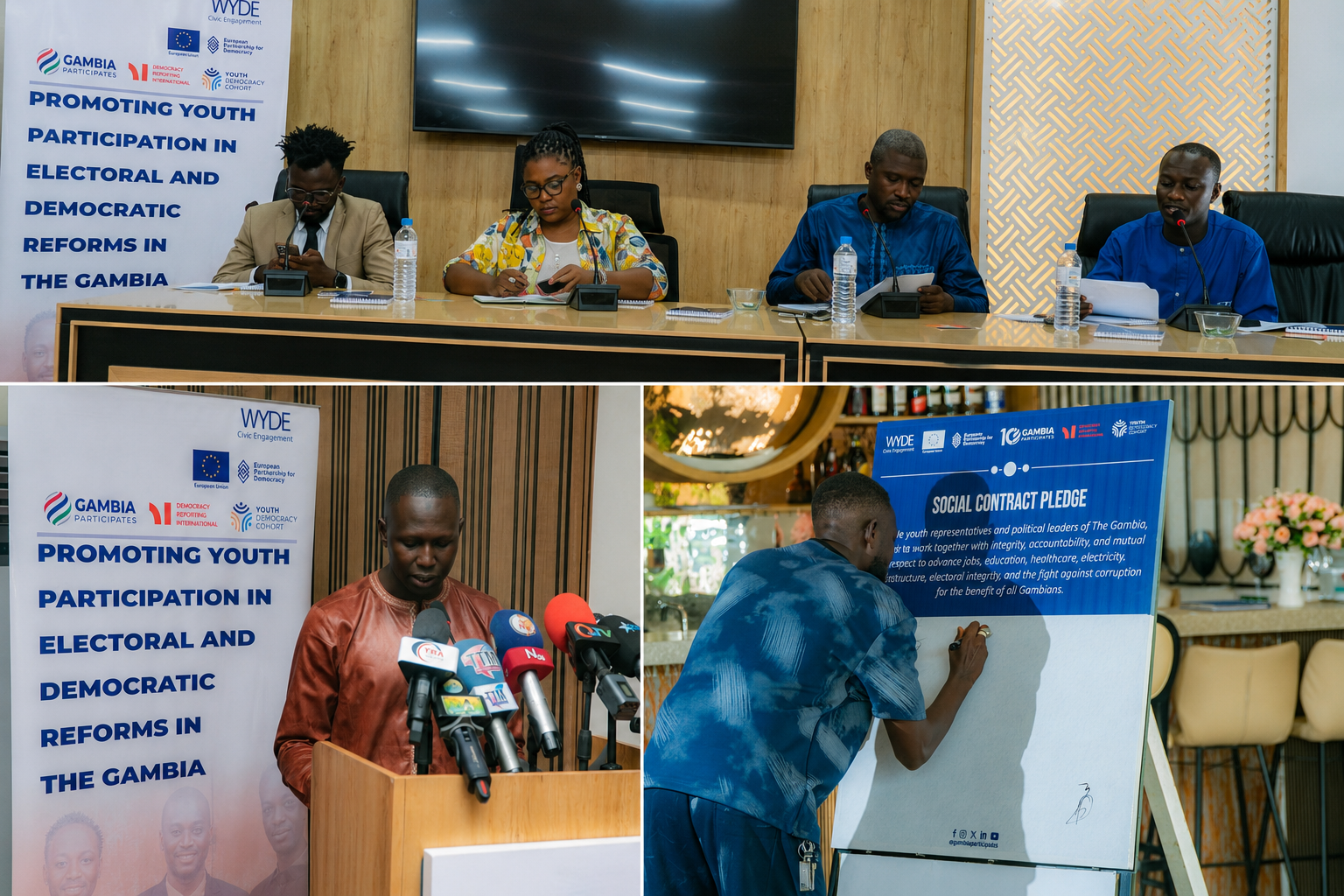
The signing ceremony, organised by Gambia Participates, was held on 27 June 2026 at a local Hotel in Kololi. It brought together Members of the National Assembly (NAMs), civil society organisations, and media representatives.
The initiative seeks to formalise commitments between elected leaders and young people, promoting transparency, mutual accountability, and citizen participation in governance.
Speaking at the ceremony, Ansumana Ceesay, Programmes Officer at Gambia Participates, described the social contract as a significant milestone in strengthening the relationship between youth and political leaders.
"We are not just here to sit or document. We are here to advance a new culture of engagement between politicians and young people—one built on trust, transparency, mutual respect, and accountability," Ceesay said.
He explained that although young people make up the majority of The Gambia's population and are central to the country's development, they continue to face numerous socio-economic challenges that limit their potential.
According to him, unemployment, limited economic opportunities, and unreliable electricity supply remain major concerns affecting the livelihoods of many young Gambians. He added that young people are also demanding greater transparency in governance, stronger public accountability, effective anti-corruption measures, and credible electoral processes.
Ceesay noted that the social contract is intended to create a platform where political leaders and young citizens can work together to address these challenges through dialogue and shared responsibility.
Members of the National Assembly who attended the event pledged to place national development and the interests of young people above political and personal considerations.
Modou Lamin Bah, National Assembly Member for Banjul North, reaffirmed his commitment to youth empowerment.
"I will prioritise young people because I understand the country's demographic realities. As a representative, I believe my people are my strength," Bah said.
Representatives from the media also welcomed the initiative, emphasising the important role journalists play in amplifying young people's voices.
One media representative encouraged Gambia Participates to extend the social contract campaign to media houses nationwide, noting that the media has consistently provided platforms for young people to express their concerns and advocate for change.
The ceremony concluded with stakeholders formally signing the social contract, symbolising their commitment to promoting inclusive governance, strengthening accountability, and fostering greater collaboration between young people and political leaders.
The agreement marks a new step in encouraging citizen participation and ensuring that the voices of young Gambians are reflected in policy discussions and national development efforts.
Author: Fatou S. Sanyang
Comments (1)