
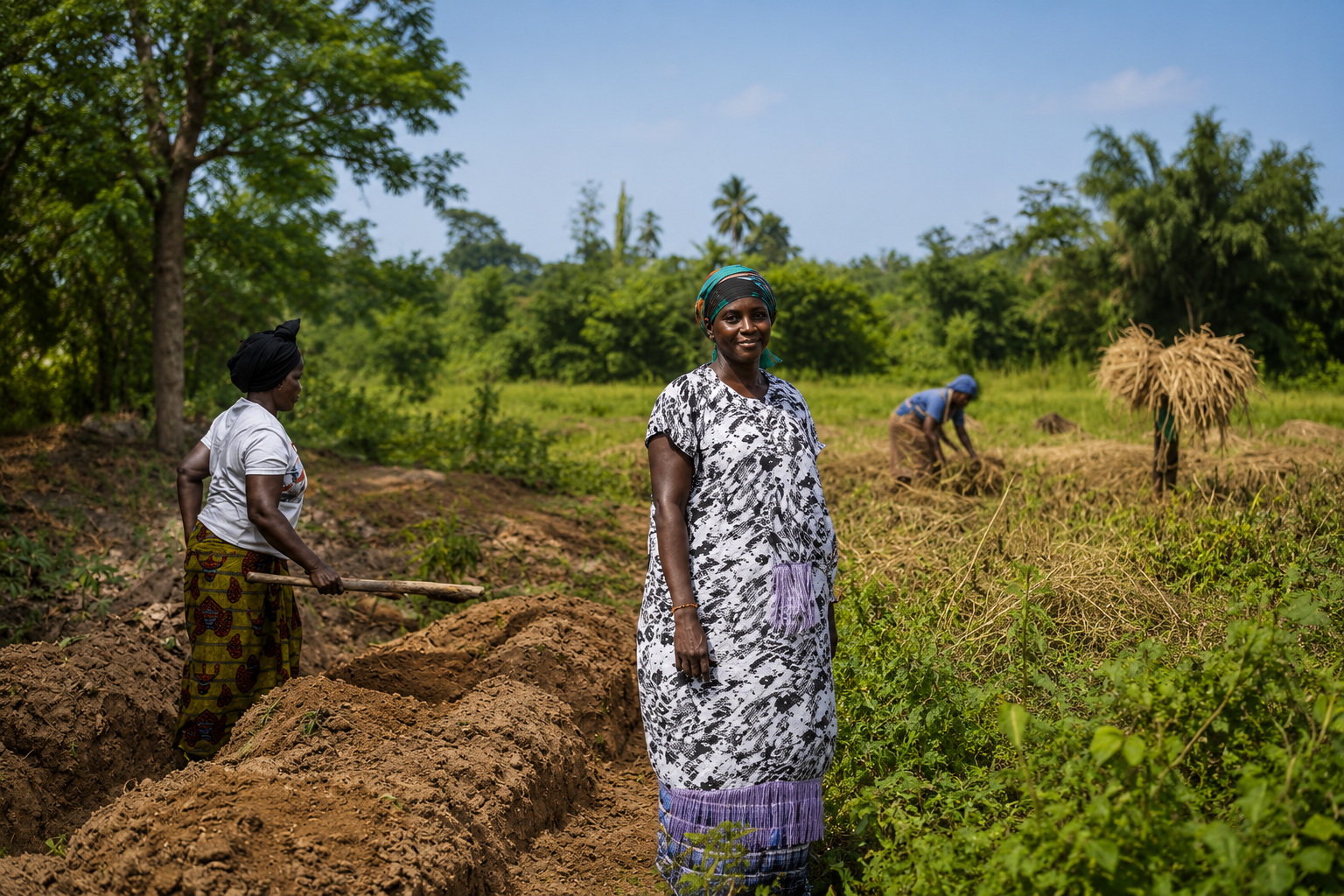
For generations, these wetlands—known locally as faros—have sustained families across Foni. Today, however, the women who cultivate them are doing more than growing food. They are strengthening household incomes, supporting local economies, and helping safeguard food security in a country that remains heavily dependent on imported rice.
Yet behind every successful harvest lies a story of exhausting labour, shrinking rural workforces, limited access to machinery, and a persistent lack of institutional support. This medium visited the women tilling the swampy wetlands in the Fonis, Gambia’s West Coast Region, in June 2026 to hear their stories.
"In Foni, farming is what we know best," says Amie Colley, a rice farmer from Kampanti Village. "At this time of year, we return to our faros to clear the land. Some of us have already raised seedlings and will begin transplanting them once the rains become steady."
Rice production in Foni is driven largely by women's farming groups, with support from government programmes and development partners that provide improved seeds and fertiliser. Most cultivation takes place in inland swamps and rain-fed paddies, where women spend weeks preparing fields before planting can begin.
But farming has become increasingly difficult.
According to Colley, the biggest challenge is labour.
"Ten years ago, there were more people to help," she says. "Now, after students finish secondary school, many leave for the towns or continue their education. Parents are left behind with only young children to assist."
Those who can afford tractors hire them to prepare their fields. Most cannot.
"If you don't have money for machinery, you spend weeks clearing and tilling the land by hand before you can even think about transplanting."
Living with her husband and three children under the age of fifteen, Colley shoulders much of the work herself. "Last week, I paid five young men 300 dalasis each just to clear a small section of my wetland."
For Mariatou Badjie, rice farming has been both a livelihood and a lifeline for more than two decades. As a widow, she has relied on her farm to feed and educate her family.
But political events beyond her control once threatened that survival.
Following the political transition in 2017 and the deployment of Senegalese troops near Bwiam as part of the regional security mission, farmers abandoned wetlands near the military camp after tensions emerged between soldiers and local communities.
"We stopped using those faros because of constant misunderstandings," Badjie recalls.
The dispute was eventually resolved through dialogue involving local elders and the area's National Assembly Member, allowing farmers to return.
"We resumed farming last year," she says. "The land had rested for several years, so it became fertile again. Our harvest was one of the best we've had."
Working in the wetlands demands extraordinary physical endurance.
The combination of standing water, thick mud and intense heat means many women work with minimal clothing to cope with the conditions.
"It becomes unbearably hot," Badjie explains. "We pour water over ourselves and spend hours bending in the mud. It is difficult work, but it is the work that feeds our families."
Local youth leader Arafang Sanneh believes Foni possesses enormous untapped agricultural potential.
"With the right investment, Foni could produce enough rice to feed at least twenty per cent of The Gambia's population," he says.
"The wetlands are here, and the people are willing to work. What is missing is equipment, irrigation systems and stronger institutional support."
Sanneh argues that expanding agricultural infrastructure could also reduce rural-to-urban migration by creating sustainable livelihoods for young people.
"Right now, most families only grow enough rice to feed themselves. With better support, rice farming could become a major source of income."
The weight of those unrealised opportunities falls most heavily on women.
For Kaddy Jammeh, a farmer from Bwiam, every farming season reflects both resilience and inequality.
"Preparing the land is twice as hard when you carry the responsibility of your household," she says. "Yet all season women transform mud into life."
She believes the women who sustain wetland agriculture continue to receive too little recognition.
"We often hear that the swamp is too harsh," she says. "But women have been cultivating these wetlands for generations. The tools are rarely designed for us, and the land is rarely registered in our names. Still, the food on the table comes from our labour."
Each rainy season, they confront leeches, scorching temperatures, aching backs and long hours standing knee-deep in water.
Even so, they return.
"We walk into the deepest mud to grow life," Jammeh says. "Our resilience runs deeper than the wetlands themselves."
As The Gambia pursues greater food self-sufficiency in the face of climate change, rising food prices and increasing import costs, the women of Foni remain at the centre of that ambition.
Their work rarely makes headlines.
But every handful of rice harvested from these wetlands tells a story of determination, sacrifice and quiet resilience—one that begins in the mud and ends on family tables across the country.
Author: Nelson Manneh
PC: Women Farmers of Foni
Comments (0)
No comments yet. Be the first to comment!