
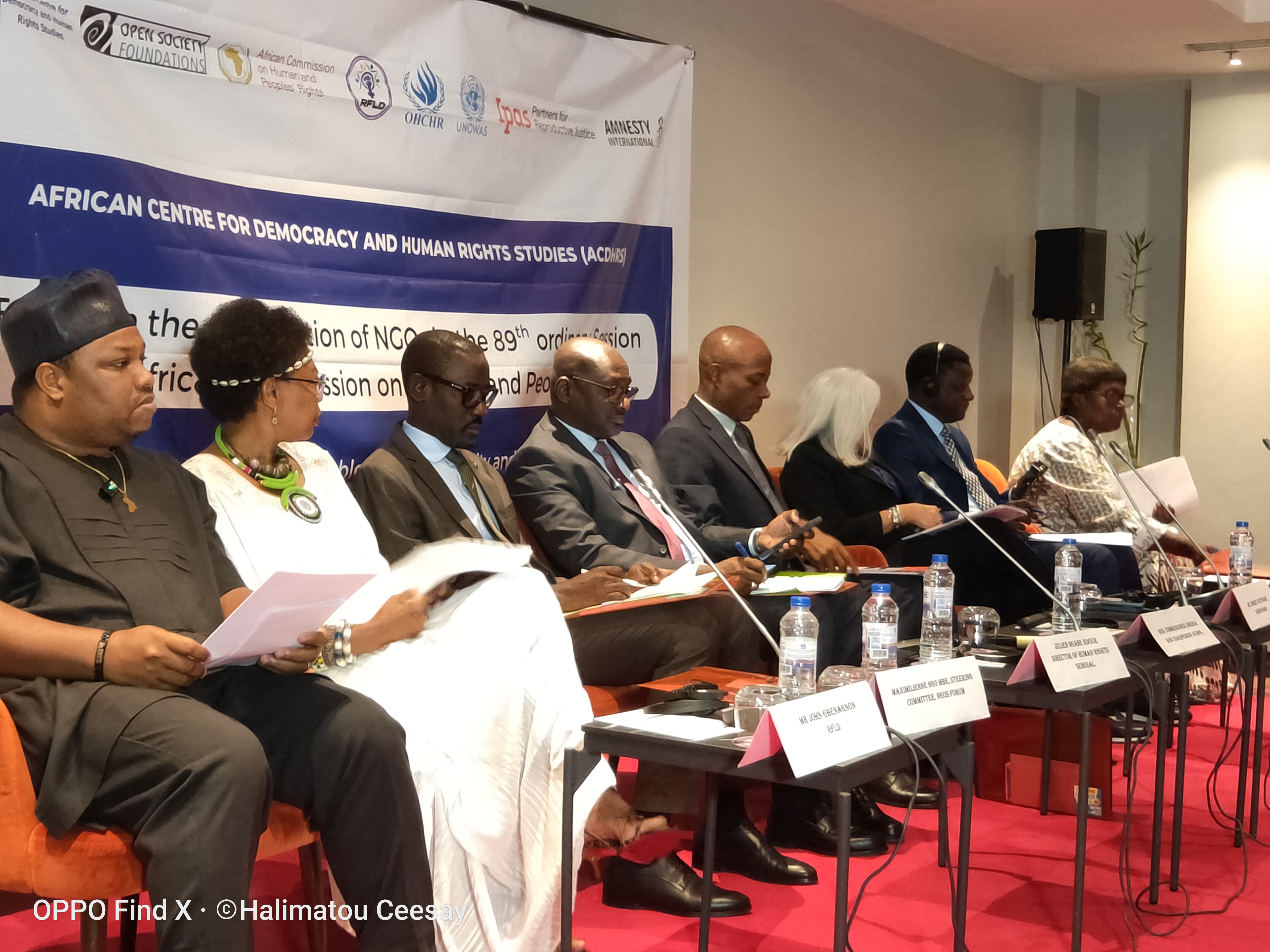
The more pressing question is whether people experience those rights in their everyday lives. This question took centre stage in Dakar, as African civil society organisations gathered for the Forum of NGOs participating in the 89th Ordinary Session of the African Commission on Human and Peoples’ Rights.
Against the backdrop of Senegal’s renowned spirit of Teranga, participants called for stronger action to transform human rights commitments into tangible improvements for communities.
The Forum, organised by the African Centre for Democracy and Human Rights Studies, will be held from 8 to 10 October 2026 in Dakar, Senegal, bringing together hundreds of stakeholders who protect, promote and defend Human Rights across the continent and beyond.
The Forum comes at a significant moment for the continent. On October 21, 2026, Africa will mark 40 years since the African Charter on Human and Peoples’ Rights entered into force—a regional framework designed to protect the rights and freedoms of African peoples.
However, as Hon. Idrissa Sow, Chairperson of the African Commission on Human and Peoples’ Rights, noted at the opening, the anniversary must be more than a celebration. It should be an opportunity for reflection on what the African human rights system has achieved, where it has fallen short, and what remains to be done.
At the heart of this reflection is a straightforward measure: whether the rights outlined in the Charter are making a tangible difference in the lives of ordinary people.
This year’s Forum focuses particularly on water and sanitation, under the theme, “Ensuring Sustainable Water Availability and Safe Sanitation Systems to Achieve the Goals of Agenda 2063.” While this topic may seem technical, speakers consistently emphasised that water is integral to human dignity.
Commissioner Sow warned about the shrinking civic space across Africa, highlighting intimidation, harassment, arbitrary arrests, abusive prosecutions, and restrictions on freedom of expression, association, and peaceful assembly. His message was clear: a human rights protection system cannot function effectively when people who report violations fear reprisals against themselves, their families, or their property.
The rights conversation in Dakar also unfolds against a rapidly changing African landscape. Climate change is intensifying droughts, floods, and water scarcity. Conflicts are displacing communities and poverty continues to undermine access to essential services.
At the same time, digital transformation and artificial intelligence present new opportunities while raising difficult questions about privacy, surveillance, freedom of expression, algorithmic discrimination, and human dignity.
Commissioner Sow urged African actors not to remain mere consumers of technologies developed elsewhere but to participate actively in shaping the standards governing their use.
Julien Ngane Ndour, the Director of Human Rights and representative of Senegal’s Minister of Justice, cautioned that the lack of safe water and adequate sanitation has far-reaching consequences beyond health.
It affects education, equality, development, peace, and human security. For women and girls, the repercussions can be especially severe. In communities with limited access to water, women and girls may spend hours collecting it, time that could be spent in school, at work, or engaging in economic and social activities.
The challenge, Ndour stated, is not a lack of laws and policies. African countries already have frameworks that recognise the importance of water and sanitation.
The greater challenge lies in implementation. Turning legal commitments into reality requires investment, effective governance, regulation, institutional stability, and long-term planning. Climate change, drought, flooding, pollution, rapid urbanisation, and conflict make this task more urgent. “States need you,” Ndour told civil society representatives, acknowledging that NGOs have valuable field knowledge and can propose solutions. The issue of water also highlighted a deeper concern about inequality.
John Gbenagnon of RFLD linked access to water and sanitation directly to women’s rights and civic space. When essential services fail, women and girls often bear a disproportionate share of the burden. For Gbenagnon, this means the African human rights system must pay greater attention to women’s access to water and sanitation by including it in State reporting and by implementing the Maputo Protocol.
He also called for increased resources to support grassroots women’s rights organisations, emphasising the need to help rural women’s groups repair community water infrastructure and address local needs.
His message was clear: rights must encompass those often excluded from decision-making spaces. The rural woman waiting for her first grant, the woman struggling to access water, and the community defender forced into exile must all be recognised as part of the African human rights narrative.
However, those working to share these stories and demand accountability face increasing vulnerability themselves.
Barrie Lynne Freeman, the Special Representative of the United Nations Secretary-General for West Africa and the Sahel, echoed these concerns. Freeman emphasised the essential role that NGOs and human rights defenders play in documenting violations, monitoring public policies, raising awareness, amplifying community voices, preventing conflict, and supporting peacebuilding.
However, these organisations increasingly operate in a difficult environment marked by restrictions, harassment, criminalisation, digital surveillance, and limited resources. Freeman argued that for civil society to contribute meaningfully to governance, it needs safe, enabling civic spaces where organisations can speak out, organise, access information and resources, and participate in decisions affecting their communities.
These emerging challenges underscore the critical role of civil society. Robert Kotchani of the OHCHR West Africa Regional Office emphasised that civil society organisations are vital for documenting violations, supporting victims and survivors, presenting evidence before human rights mechanisms, advocating for justice, and monitoring the implementation of recommendations.
He also stressed that access to water and sanitation should be understood through the lenses of equality, dignity, and participation, especially for communities that face barriers to essential services.
Perhaps the most important message is that human rights cannot be confined to conference rooms, legal documents, or official declarations. They must reach the woman collecting water before sunrise, the girl missing school because of a lack of safe sanitation facilities, and rural organisations waiting for resources to address issues in their communities. They must also protect journalists, activists, and human rights defenders who document violations and ask difficult questions.
Furthermore, ordinary citizens must be empowered with the knowledge and space to understand, claim, and utilise their rights. This is why the NGO Forum remains significant.
As Africa approaches the 40th anniversary of the African Charter, the gathering in Dakar offers an opportunity to measure progress not only by the number of laws adopted or declarations made, but by the lives transformed. The strength of the Charter ultimately depends on whether people can understand, claim, and use their rights to improve their lives. Thus, the next chapter of Africa’s human rights story cannot be written solely by governments and institutions.
It must also be shaped by communities, civil society organisations, women, young people, defenders, and ordinary citizens, whose daily experiences reveal where the promises of human rights are succeeding and where they are still falling short.
In Dakar, the message was unmistakable: the time for declarations must be matched by action. The true measure of Africa’s human rights system lies not only in what it promises, but in what people can experience, access, and enjoy in their everyday lives.
Author: Halimatou Ceesay
PC: Members of the high table
Comments (0)
No comments yet. Be the first to comment!