
However, in various regions of Africa, communities that face discrimination due to their work and descent often find themselves excluded from essential public services such as water and sanitation, as well as from the decision-making processes that affect their lives.
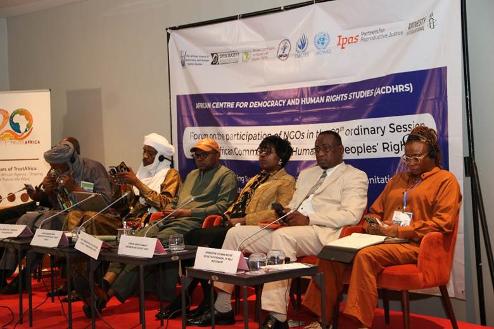
These issues were the focus of an inaugural panel discussion titled “From Exclusion to Equal Participation — Advancing Water Justice and Democratic Inclusion for Communities Discriminated Against Based on Work and Descent in Africa.”
The session held on 8th October 2026 brought together human rights experts, advocates, and representatives from affected communities to explore how discrimination rooted in ancestry, occupation, and social status perpetuates inequality. Moderated by Abdarahmane Wone, Communication Specialist at TrustAfrica, the panel included Hon. Commissioner Litha Musyimi Ogana, Dr Moussa Zangaou, Ibrahim Ag Idbaltanat, Barrister Uzumma Kathy, Chieck Sidati Hamady, and Brahim Bilal Ramdhane.
The discussion emphasised the links between water insecurity, historical discrimination, and democratic exclusion.
Water Access as a Human Rights Issue
Hon. Commissioner Litha Musyimi Ogana emphasised the African Commission on Human and Peoples’ Rights’ work in recognising and addressing discrimination against communities affected by work- and descent-based exclusion.
She highlighted Article 2 of the African Charter on Human and Peoples’ Rights, which guarantees the enjoyment of the rights and freedoms set out in the Charter without discrimination on the grounds specified.
Commissioner Ogana discussed the Commission’s efforts to improve understanding of the experiences of affected communities and to strengthen responses to the inequalities they face. She referred to the Commission’s resolution on discrimination based on work and descent, which calls for a continental study to deepen understanding of this issue.
Furthermore, she emphasised the importance of engaging traditional leaders to challenge discriminatory cultural practices that continue to reinforce social exclusion. However, she stressed that recognition and policy commitments must translate into tangible improvements in people’s lives.
Drawing on her visit to a marginalised community in Niger, she shared an example of how Timidria, an organisation working to combat discrimination, improved the community's access to water by constructing a borehole, thereby changing its circumstances. This example illustrated how practical interventions can address immediate needs while contributing to broader efforts to restore dignity and promote equality.
Commissioner Ogana encouraged civil society organisations across Africa to identify communities excluded from essential services and to pursue initiatives that meet their specific needs. She emphasised the importance of combining advocacy and legal protection with practical actions that can deliver measurable change.
When discrimination determines who gets water
The experience of Timidria in Niger highlights how ancestry-based discrimination can affect the distribution of public infrastructure and determine which communities benefit from development programmes.
During the discussion, the panel explored how communities excluded from planning and decision-making processes often lack access to essential water facilities, even when infrastructure projects are implemented in nearby areas. For families without nearby boreholes, obtaining water can become a daily struggle.
Women, children, and older people may be forced to travel long distances to meet household needs, losing valuable time that could be spent on education, livelihoods, caregiving, and other activities.
These inequalities show that water insecurity is not solely a matter of inadequate infrastructure. In many cases, it is also linked to who is recognised, whose needs are prioritised, and who has a voice in determining how public resources are allocated.
The panel emphasised that achieving water justice requires more than the construction of boreholes and similar facilities. It demands transparent planning, fair distribution, accountable management, and meaningful participation by communities that have historically been marginalised. Without these safeguards, development programmes risk perpetuating the very inequalities they aim to address.
Chieck Sidati Hamady highlighted the injustices faced by communities in Mauritania who experience discrimination based on work and descent, particularly the Haratin community.
His contribution highlighted the disparities in access to education, public representation, essential services, and participation in public life.
These inequalities demonstrate how historical and social hierarchies continue to shape opportunities and restrict affected communities' ability to exercise their rights on an equal basis with others.
Hamady emphasised the need to recognise and document these forms of discrimination using reliable information and evidence. He noted that improved documentation is crucial for understanding the extent of exclusion, informing policy responses, and strengthening accountability. He also stressed the importance of ensuring that affected communities are included in decision-making processes, rather than being treated merely as beneficiaries of development interventions.
His contribution reaffirmed the need for African institutions and civil society organisations to monitor progress toward equality, advocate for equitable access to public services, and ensure that commitments to inclusion result in tangible outcomes.
Water, Dignity, and Democratic Participation
Brahim Bilal Ramdhane emphasised that access to water must be understood in light of the broader principles of justice, dignity, and equality, particularly for communities that have endured generations of exclusion. He explained that water insecurity cannot be separated from wider inequalities affecting education, healthcare, housing, employment, and infrastructure. When communities are denied equal access to these essential services, their ability to participate fully in social, economic, and political life is undermined.
The discussion emphasised the importance of recognising marginalised communities as rights-holders and equal participants in development and governance. Their experiences, priorities, and knowledge must inform decisions on the resources and services that directly affect them.
Democratic inclusion requires more than merely allowing communities to attend public consultations. It demands that their voices are heard, their concerns are taken seriously, and their participation influences policies, budgets, and the distribution of public resources.
From Commitments to Meaningful Change
Throughout the discussion, a central message emerged: discrimination based on work and descent is not just a social issue but also a human rights and development concern that requires coordinated action.
Addressing this issue calls for stronger legal protections, reliable data, inclusive policymaking, effective monitoring, and sustained engagement with affected communities. Traditional leaders, governments, human rights institutions, and civil society organisations all have roles to play in challenging discriminatory practices and ensuring that public services are accessible to everyone.
The panel also emphasised the importance of linking high-level advocacy to community-led solutions. For instance, the example of the borehole in Niger showed how a practical intervention can make a significant difference, while the broader discussion revealed the need to ensure that such interventions are planned and implemented equitably.
Ultimately, advancing water justice means confronting the structures that perpetuate exclusion. It involves ensuring that a person's ancestry, occupation, or social background does not determine their access to clean water, essential public services, or participation in decisions that affect their future.
As African countries pursue inclusive development and democratic governance, the experiences of communities discriminated against based on work and descent must remain central to these efforts.
The transition from exclusion to equal participation requires more than promises; it demands accountability, inclusive institutions, and concrete action to ensure every community can enjoy its rights with dignity and equality.
Author: Halimatou Ceesay
PC: Panellist
Comments (0)
No comments yet. Be the first to comment!