
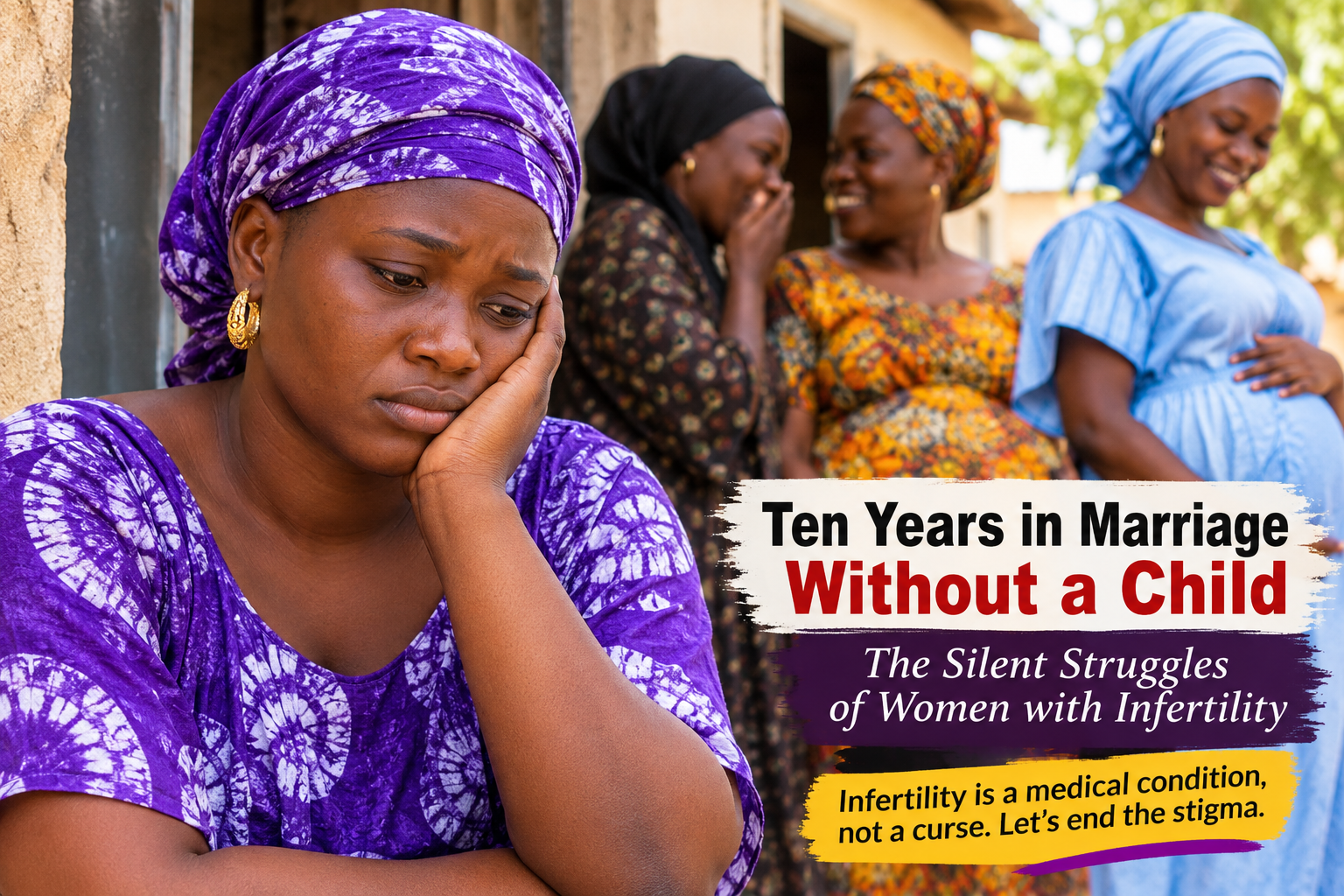
For ten years, Manta Manneh (not her real name) has endured the emotional and psychological burden of infertility in her matrimonial home. In a society where motherhood is often regarded as a defining measure of womanhood and a woman's place in marriage, her inability to conceive has exposed her to stigma, ridicule and painful experiences that continue to haunt her.
Over the years, she has tried almost everything in the hope of having a child. From traditional herbal remedies and hospital visits to prayers, consultations with marabouts and participation in “Kanyaleng Kafoo” (traditional Communicators) gatherings, she has pursued different paths in search of motherhood.
But beyond her efforts to conceive lies another struggle: the persistent judgment of people around her.
In an interview with SheTale Media Network in October 2026, Manta recounted some of the painful experiences she has endured throughout her nearly decade-long marriage. She described living in an environment where her childlessness has become a subject of ridicule, even among people she once considered close to her.
Recalling one particularly painful incident, she said one of her co-wives, who was pregnant at the time, made a remark that left her deeply hurt.
"One of my co-wives in the compound was pregnant, and I was cracking jokes with her one day when she reminded me that she was not married to joke, which is why she was pregnant, unlike me," she recalled.
The remark came from someone she considered a friend within the household, making it even more difficult to accept.
"I felt so bad that it still hurts whenever I remember those words," she said.
For Manta, the pain of infertility is not limited to the inability to have a child. It is compounded by the humiliation of constantly being reminded of something over which she has little control.
Her experience reflects the realities of many women in The Gambia who face societal expectations that equate motherhood with a woman's value, particularly within marriage. Childlessness can expose women to discrimination, emotional abuse, marital insecurity and the fear of rejection.
What makes the situation even more troubling is the tendency to assume that infertility is always a woman's problem, despite medical evidence that male factors also contribute significantly to difficulties in conceiving.
The pain behind the silence
Fanta Sanneh (not her real name), another woman who experienced infertility in her marriage but has since become a mother, understands the emotional burden that comes with the condition.
For five years, she endured questions, accusations and the pressure to become pregnant. According to her, the scrutiny began at her workplace shortly after her husband returned from abroad.
Colleagues and acquaintances repeatedly asked when she would become pregnant. Over time, the questions became accusations, with some people suggesting that her husband was incapable of fathering a child.
The constant attention to her reproductive life turned what should have been a private matter between her and her husband into a subject of public discussion.
Her experience at home was equally painful.
Fanta recalled an incident involving her co-wife's child, whom she had disciplined at school in her capacity as a teacher. Upon returning home, she was confronted by her co-wife, who accused her of mistreating the child because she did not have children of her own.
"I disciplined my co-wife's child at school as his teacher. When I returned home, my co-wife attacked me and said I did not know the joy of having a child, which was why I beat her child. That pain will never heal in my heart," she recounted.
Although Fanta has since become a mother, the experience has left emotional scars.
Her story illustrates how infertility-related stigma can extend beyond questions about pregnancy to affect women's relationships, professional lives and everyday interactions.
What do the numbers tell us?
While the personal experiences of women like Manta and Fanta reveal the human cost of infertility, available medical research also points to a significant reproductive health concern in The Gambia.
A 2024 research paper titled The Trajectories of Infertility in The Gambia, published in the Annals of Medical and Health Sciences Research, reviewed available literature on infertility between 1998 and 2023.
The review reported infertility estimates of 9 per cent in 1998, 12.6 per cent in 2012 and 14.3 per cent in 2017. It also reported a figure of 19.3 per cent in 2023.
However, these figures were drawn from different studies and clinical settings and should not be interpreted as results from a single nationwide survey. The 2017 figure was associated with research at the Gambian Teaching Hospital, while the 2023 figure came from a specialist hospital's retrospective review.
The 2023 study examined 1,475 women attending a gynaecology clinic, identifying 285 couples experiencing infertility.
The findings also challenged the common assumption that infertility is predominantly a woman's problem. Male-related factors accounted for 45.4 per cent of the identified causes in the 2023 hospital study, while ovulatory disorders accounted for 22.4 per cent, tubal factors 13.2 per cent, unexplained causes 13.8 per cent and uterine factors 5.3 per cent.
These findings reinforce the importance of investigating both partners when couples experience difficulties conceiving.
More importantly, the country still lacks a comprehensive, nationally representative estimate of infertility prevalence.
A separate study published in 2022 in BMC Health Services Research, which assessed infertility services in 38 public and private health facilities across The Gambia, identified significant gaps in the availability of specialised diagnostic and treatment services.
The research found that advanced infertility investigations and treatment were more accessible in private facilities, while assisted reproductive technologies were unavailable in the country at the time of the survey. It also highlighted weaknesses in the collection and reporting of infertility data.
A further 2024 study, titled It's About Time: Policymakers' and Health Practitioners' Perspectives on Implementing Fertility Care in the Gambian Health System, identified inadequate financing, limited specialised training and the absence of routinely collected infertility data as major barriers to effective fertility care.
Although the Ministry of Health has included infertility-related interventions in its National Reproductive Health Strategy, the researchers noted that translating these commitments into accessible services remains a challenge.
Infertility is not exclusively a woman's problem
Speaking to SheTale Media Network, midwife and fertility specialist Abdou Panneh explained that infertility can result from several medical conditions affecting either partner.
According to Panneh, the causes may be associated with women, men or a combination of factors affecting both partners. He estimated that approximately 50 per cent of cases he encounters are attributable to women, 40 per cent to men and 10 per cent to both partners. These figures reflect his professional assessment rather than nationally established statistics.
He explained that female infertility can result from ovulation disorders, where the ovaries fail to release eggs regularly or adequately for fertilisation.
Other possible causes include blocked or damaged fallopian tubes, uterine conditions and reproductive tract infections.
Panneh particularly highlighted pelvic inflammatory disease (PID), an infection-related condition that can damage the female reproductive organs and affect a woman's ability to conceive.
"There is one serious problem in my own studies and experience as a fertility specialist. I discovered that about 50 to 60 per cent of women that I have come across have infertility due to PID (pelvic inflammatory disease), which is also a form of infection," he said.
He also identified sexually transmitted infections, including gonorrhoea and chlamydia, as possible contributors to reproductive complications when left untreated.
For men, infertility may be associated with low sperm production, poor sperm movement, abnormal sperm structure and other reproductive or hormonal conditions.
His explanation reinforces the need for couples experiencing difficulties conceiving to seek medical assessment together rather than placing the responsibility entirely on women.
What do religion and faith say?
In a society where religion plays an important role in family and community life, faith is often a source of comfort for couples experiencing infertility. However, religious beliefs can also be misinterpreted and used to justify the humiliation of childless women.
Imam Ismaila Jatta condemned the practice of mocking or discriminating against people because of their inability to have children, stressing that such behaviour contradicts the values of compassion and respect promoted by Islam.
He explained that children are blessings from Allah and that their provision is ultimately determined by God.
According to him, the Qur'an teaches that Allah grants children to whom He wills, whether male or female, and may leave others without children.
He therefore encouraged families and communities to exercise patience, compassion and understanding rather than subjecting couples to ridicule.
Pastor Bakary Camara also shared a Christian perspective, emphasising that infertility should not become a reason to discriminate against either partner.
He noted that women are often blamed more than men, even though infertility can affect both sexes.
"The Bible clearly teaches that children are an inheritance from God, so couples should understand that it is neither necessarily the fault of the man nor the woman," he said.
Both religious leaders emphasised the importance of compassion and discouraged the practice of judging couples based on their reproductive circumstances.
Beyond motherhood: Restoring dignity and support
For women like Manta, the journey through infertility is about more than the desire to become mothers. It is also about the right to live with dignity, free from humiliation, discrimination and the constant pressure to prove their worth through childbirth.
Fanta's experience further demonstrates that even when a woman eventually conceives, the emotional wounds caused by years of stigma may not disappear.
Infertility is a medical and reproductive health condition, not a measure of a woman's worth, a punishment or evidence of personal failure. It can affect either partner, and sometimes both.
The absence of reliable national data, limited access to specialised fertility services and inadequate public awareness further complicate the situation for couples seeking assistance in The Gambia.
There is therefore a need for stronger public education, improved reproductive health services, affordable diagnostic and treatment options, and more systematic national data collection.
Equally important is the need to challenge the cultural attitudes that place the burden of infertility almost entirely on women.
Until families and communities begin to understand that having children is not the sole measure of a woman's identity or value, women like Manta Manneh will continue to endure a painful struggle that often remains hidden behind the walls of their matrimonial homes.
No woman should have to endure humiliation simply because she has not become a mother.
Author: Fatou S. Sanyang
PC: AI-Generated
Comments (1)