
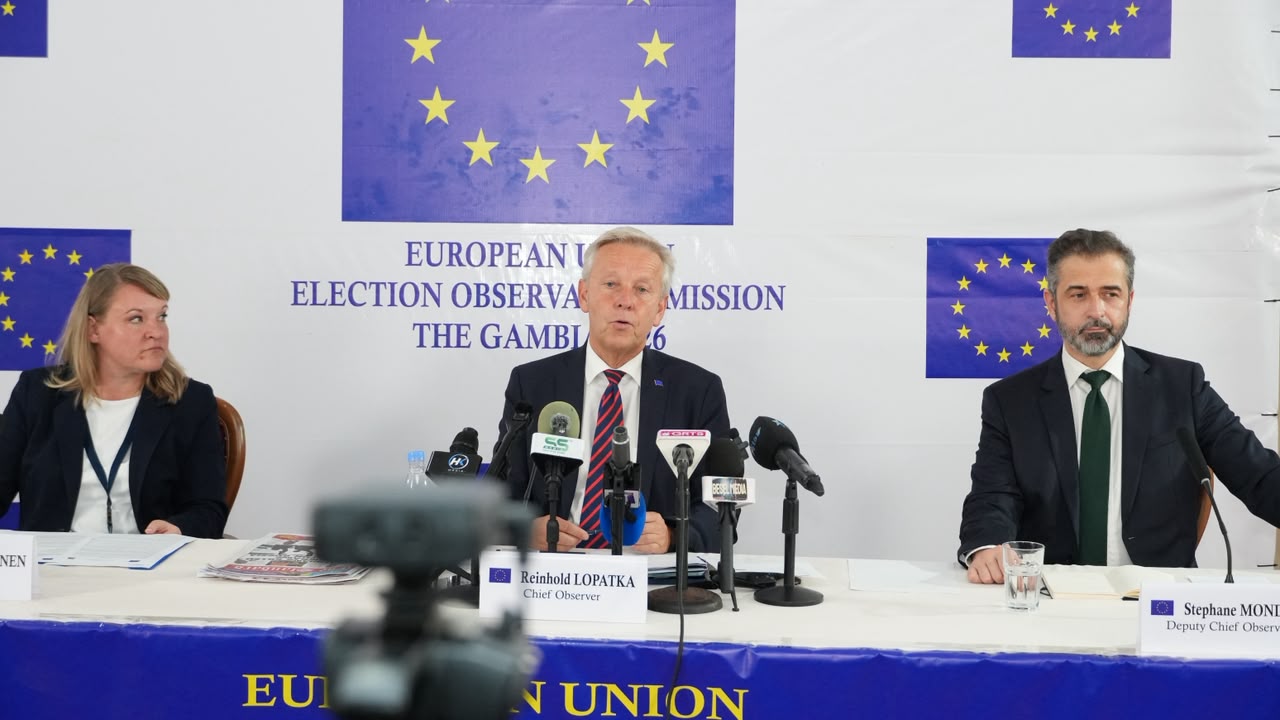
The announcement was made on Thursday, November 5, 2026, during the official launch of the mission at a press conference held at the Ocean Bay Hotel in Banjul.
The mission is headed by Chief Observer Reinhold Lopatka, a Member of the European Parliament, following an invitation from the Gambian authorities. This marks the third time since 2017 that the European Union has deployed an election observation mission to The Gambia for national elections.
The 16 long-term observers, drawn from 15 EU member states and Switzerland, will work alongside a core team of eight analysts who arrived in the country on October 21 and are based in Banjul.
As part of their mandate, the observers will engage with election officials, presidential candidates, political parties, civil society organisations and media representatives to assess various aspects of the electoral process.
Speaking at the launch, Chief Observer Lopatka described the December election as an important opportunity for The Gambia to further consolidate its democratic institutions.
He said the mission's nationwide presence is intended to contribute to an inclusive, credible and transparent electoral process, where all eligible candidates can participate, and voters are able to make their choices freely.
The EU EOM will assess the presidential election against The Gambia's legal framework, as well as international and regional standards and commitments governing democratic elections.
The mission's team of analysts will also monitor traditional and digital media, including newspapers, television, online platforms and social media, to evaluate the broader electoral environment.
The observation mission is expected to expand its operations closer to election day with the deployment of 20 short-term observers, seven Members of the European Parliament and additional locally recruited observers from EU member states and partner diplomatic missions accredited to The Gambia.
Lopatka disclosed that the mission will remain in the country until December 21, allowing it to observe the vote-counting process and the handling of electoral disputes.
He, however, clarified that the EU Election Observation Mission has no mandate to certify or validate election results, emphasising that this responsibility lies with the relevant Gambian authorities, particularly the Independent Electoral Commission (IEC).
During his visit, Lopatka held consultations with key national institutions and stakeholders, including the IEC, the Chief Justice, the Minister of Foreign Affairs, the National Human Rights Commission, political party representatives, media practitioners, civil society organisations, religious leaders and domestic election observers.
He is expected to return to The Gambia in December to present the mission's preliminary findings at a press conference two days after election day.
The European Union has continued to support electoral and institutional reforms in The Gambia, particularly initiatives aimed at strengthening independent institutions, promoting the rule of law and protecting human rights.
The mission expressed hope for a peaceful and competitive electoral process, free from violence, where diverse political views can be expressed, and citizens can freely choose their representatives.
By Kaddy Sowe
Comments (0)
No comments yet. Be the first to comment!