
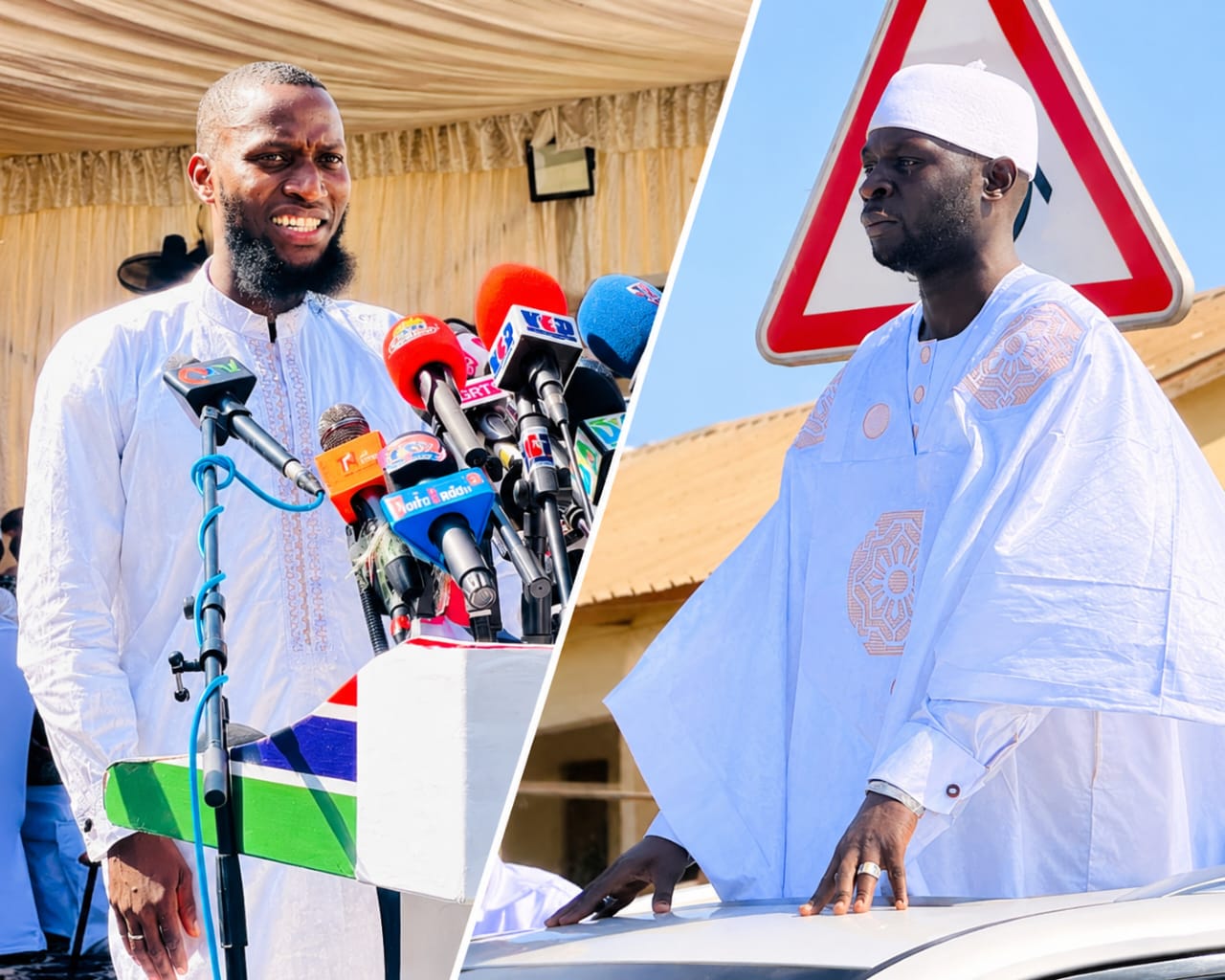
While Bojang sought to distinguish himself through what he described as his personal commitment to development and contributions to key sectors, Badjie focused on national debt, corruption, accountability and the need for fundamental changes in governance.
Bojang: “I am different from them”
NDP flag-bearer Kebba Madi Bojang, who submitted his nomination papers on Friday, November 6, 2026, told journalists that his political identity was built around development and his personal efforts to support Gambians, rather than conventional party politics.
“I am different from them because I believe in development, and I use my own resources to help Gambians,” he declared.
Bojang, a former youth president of the National People's Party (NPP), said his previous political involvement and contributions to national development had earned him the confidence of Gambians.
He pointed to his involvement in the agriculture and education sectors, arguing that his contributions to these areas demonstrated his commitment to improving people's lives.
“If you go to the agriculture and education sectors, my hands are there,” he said.
On the possibility of political alliances ahead of the December election, Bojang expressed willingness to work with opposition parties, suggesting that partnerships could be necessary to strengthen the opposition's chances.
However, he categorically ruled out any possibility of an alliance with the governing NPP.
“That can happen between the opposition parties and me, but not the incumbent,” he stated.
Despite presenting himself as a development-oriented alternative, Bojang's nomination remains subject to the fulfilment of outstanding requirements identified by the IEC.
The Commission requested additional documentation, including proof of a Senior Secondary School Certificate, a campaign itinerary and properly signed nomination documents. He has until November 14 to address the outstanding requirements and discrepancies identified in his submission.
Badjie: Debt, corruption and accountability take centre stage
Meanwhile, independent presidential aspirant Bakary K. Badjie, 37, submitted his nomination papers to the IEC on Thursday, November 5, 2026, using the opportunity to raise concerns about the country's economic situation and governance record.
Addressing journalists after completing his nomination, Badjie described The Gambia as a country at a crossroads, questioning the direction of its development despite years of political leadership and public investment.
He cited a national debt of D144 billion and claimed that approximately 50 per cent of public institutions were operating from rented premises, raising concerns about government spending and the management of public resources.
Badjie also highlighted persistent challenges in public service delivery, particularly unreliable electricity supply and difficulties within the healthcare system.
He questioned what kind of country Gambians wanted to build, arguing that the country's development ambitions could not be achieved without confronting corruption and addressing weaknesses in public administration.
On why voters should trust him with the presidency, particularly regarding his record of service to his constituents, Badjie pointed to his work in the National Assembly.
He referenced what he described as his recognition as the recipient of the best-performing and most unstable parliamentary award, presenting the achievement as a milestone in his public service journey and one that reflected his contributions to national development.
He said his parliamentary work had centred on representing his constituency and supporting legislation aimed at improving governance and addressing the country's challenges.
The independent aspirant further criticised what he described as the distribution of state lands among parliamentarians, ministers, presidents and vice presidents, arguing that such practices undermined public trust and contradicted the principles of fairness and accountability.
For Badjie, the fight against corruption is central to national development. He argued that resources lost through corruption could instead be channelled into productive sectors, particularly agriculture, to create opportunities and improve livelihoods.
He maintained that political leadership should be understood as a responsibility to serve citizens rather than an avenue for personal enrichment, insisting that integrity, transparency and accountability must guide the management of public affairs.
Two aspirants, different approaches to national development
Although both candidates presented themselves as alternatives in the December 5 presidential race, their messages reflected different approaches to addressing The Gambia's development challenges.
Bojang emphasised his personal involvement in development initiatives, particularly in agriculture and education, while signalling openness to opposition cooperation against the incumbent government.
Badjie, on the other hand, placed greater emphasis on institutional accountability, the country's debt burden, corruption and the need to improve public service delivery.
Their submissions add to the growing political activity ahead of the December election, as presidential hopefuls seek to convince Gambians that they have the leadership capacity and vision to address the country's pressing challenges.
With the election approaching, voters will be looking beyond campaign promises to examine the candidates' records, policy proposals and practical plans for tackling unemployment, economic hardship, corruption, healthcare, education and agricultural development.
The December 5 election will ultimately provide Gambians with an opportunity to decide which vision and leadership approach best reflects their aspirations for the country's future.
Author: Fatou S. Sanyang
Comments (0)
No comments yet. Be the first to comment!