
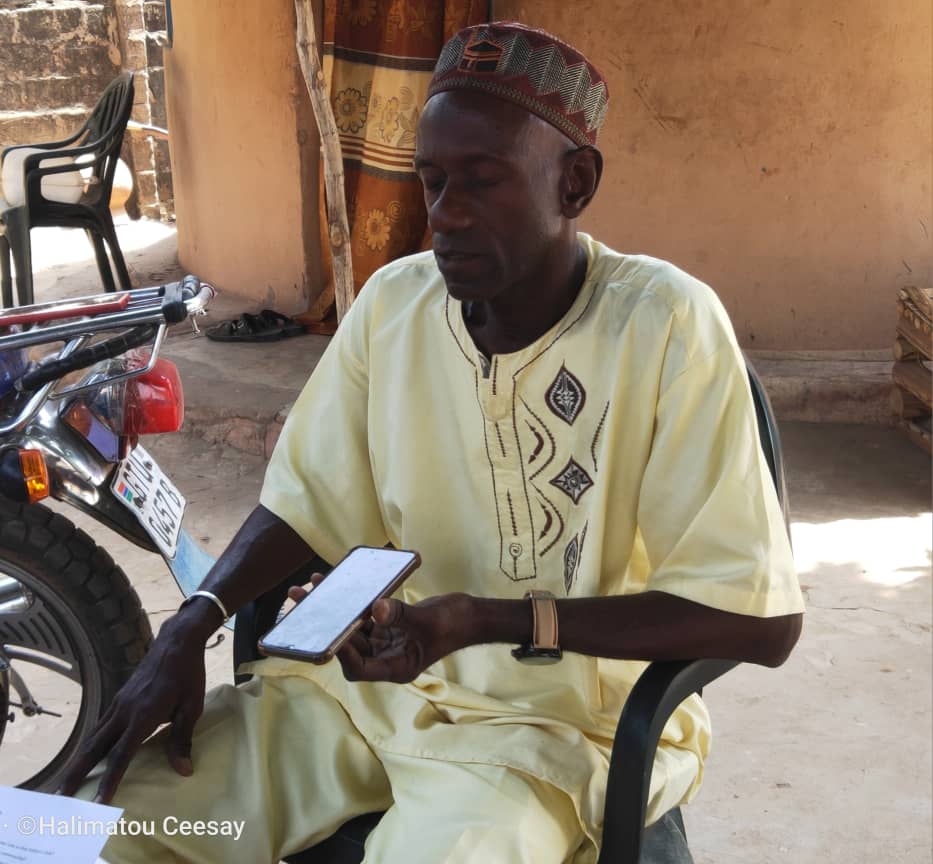
The Fathers Club, formed just a year ago, emerged from a simple realisation: if mothers could organise to strengthen families, fathers needed to step forward too.
Speaking to this reporter on April 18, 2026, Malie said, “The mothers' club was already doing a lot for families. “So, we saw the need for fathers to join hands with them for the betterment of the home.”
For Malie, leadership in the Fathers Club is not new territory. Before taking on this role, he served as a regional coordinator for GAMCOTRAP under the leadership of Dr. Isatou Touray. That experience exposed him to advocacy work and deepened his understanding of issues affecting women and girls—especially FGM.
“What we are doing in the Fathers Club is similar,” he says. “It made me feel obliged to be part of something that can create real impact.”
But Malie’s journey into FGM advocacy is also deeply personal—and marked by regret.
“I have many daughters,” he says quietly. “But two of them went through FGM because I did not understand the implications at the time.”
That realisation came later in life, after attending trainings and hearing firsthand accounts of the physical and emotional toll FGM takes on women. What he learned changed everything.
“FGM is not proper. It is not the word of God. It is not part of our religion,” he says firmly. “And it comes with a lot of complications.”
Malie describes those complications in stark terms—complications that often remain hidden until much later in life. From severe pain and medical risks to difficulties in marriage, the consequences, he says, are far-reaching.
“When it is done, you may not see the effects immediately,” he explains. “But when these girls grow up, that is when the suffering begins.”
He recounts painful realities: young girls held down during the procedure, women later subjected to further cutting after marriage, and relationships breaking down under the weight of complications that few openly discuss.
“I have seen marriages fail because of this,” he says. “People blame each other, but they don’t talk about the real cause.”
Among the most tragic experiences he recalls is witnessing a young girl bleed to death after undergoing FGM—an incident that left a lasting mark on him.
“These are things I cannot forget,” he says.
For years, however, such stories were rarely spoken about. In Malie’s youth, FGM was seen as an unquestionable tradition. Girls who were not circumcised risked being labelled as outcasts, and the practice was upheld across communities.
But today, that narrative is beginning to shift.
Through the Fathers Club and earlier advocacy efforts, Malie has been actively engaging his community—organising meetings, leading discussions, and encouraging both men and women to reconsider long-held beliefs.
The club’s first major gathering, held at the Agric Camp in Giroba, brought together people of all ages. Since then, trainings and community dialogues—including sessions with members of the female lawyers’ association—have strengthened the movement.
“I have seen people I never expected speak up against FGM,” Malie says. “That shows change is possible.”
He believes one of the most critical elements in ending FGM is male involvement.
“If men are not involved, the practice will not stop,” he says. “This is not only a woman’s issue.”
As heads of households, Malie argues, men have both influence and responsibility. They can protect their daughters, support their wives, and challenge harmful practices within their families.
In his own home, he has taken a firm stand—going as far as warning relatives that he would take legal action if anyone attempted to subject his daughters to FGM.
“I made it clear to everyone,” he says. “No one should try it.”
His stance extends beyond his family. In the wider community, he has confronted practitioners and worked with organisations like GAMCOTRAP to encourage them to abandon the practice.
The impact is visible. According to Malie, what was once nearly universal in his village has now dropped dramatically.
“If it was one hundred per cent before, now it is about one per cent,” he says.
Still, challenges remain. Tradition remains a powerful force, and changing mindsets takes time.
“You cannot change something people have practised for generations overnight,” he says. “But with continuous sensitisation, it is possible.”
For Malie, the work is far from over. He continues to call on fathers across the country to take responsibility—not just as providers, but as protectors and advocates for their children.
“Stand up,” he urges. “Talk to your families. Attend meetings. Support the efforts to end this practice.”
In Basse, the Fathers Club is proving that when men step into the conversation, change becomes more than an idea—it becomes a reality.
And for Malie Baldeh, that change is not just about advocacy. It is about ensuring that no more daughters suffer in silence.
This story is part of the "Breaking the Silence: Voices of FGM Survivors" podcast funded by the Foundation for Women's Health, Research and Development (FORWARD UK).
Author: Kaddy Sowe
PC: Malie Baldeh
Comments (1)