
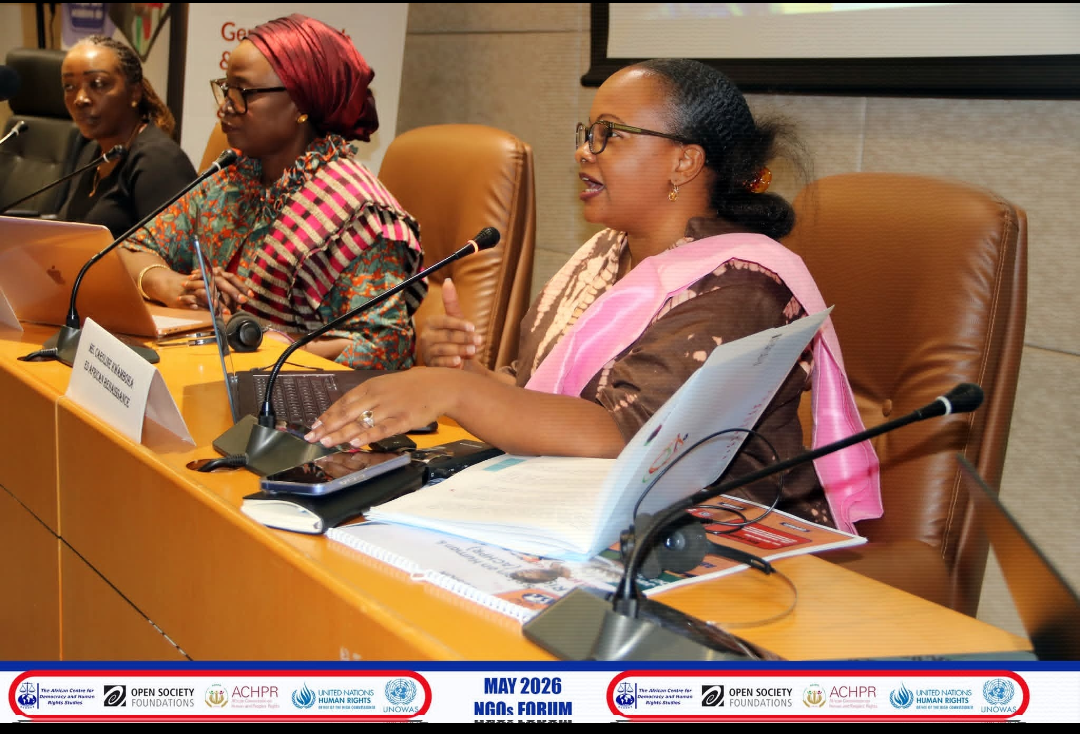
Held on May 7, 2026, at the Sir Dawda Kairaba Jawara Conference Centre in Bijilo, under the theme “From Invisibility to Accountability to Secure Sanitation as a Right for Women and Girls in Africa,” the panel brought together human rights commissioners, policy experts, legal advocates, and development practitioners who challenged African governments and institutions to move beyond policy promises toward concrete implementation and accountability.
Moderating the session, Caroline Kwamboka set the tone by arguing that Africa’s problem is not the absence of laws and frameworks on water and sanitation, but the failure to implement them effectively.
“Our deficit lies in the conversion of existing policies into practice,” she said. “The issue is bringing to life the policies that we already have.”
Her remarks resonated strongly with participants who acknowledged that despite numerous regional and international commitments, many women and girls across the continent still lack access to safe, private, and dignified sanitation facilities.
For Commissioner Janet Sallah-Njie, sanitation must be viewed through the lens of justice and human dignity rather than infrastructure alone.
“Sanitation is not only about infrastructure,” she stressed. “It is about dignity. It is about equality. It is about the realisation of human rights.”
Speaking passionately about the realities facing women and girls, Commissioner Njie highlighted how inadequate sanitation continues to undermine education, health, safety, and social inclusion.
“When a girl misses school because there is no safe sanitation facility, her rights are violated,” she stated. “When a woman risks assault while searching for a safe place to relieve herself, her rights are violated.”
Her intervention shifted the discussion from statistics and development targets to the lived experiences of women and girls who often suffer silently due to poor sanitation systems.
The Commissioner further challenged policymakers and urban planners to recognise that sanitation systems are not gender neutral and must be designed with the realities of women and marginalised communities in mind.
“A toilet without lighting is not safe. A school without menstrual facilities is not inclusive,” she emphasised.
Representing the Nairobi River Commission, Eva Muhia drew attention to the sanitation crisis in Nairobi’s informal settlements, where overcrowding, insecurity, and poor infrastructure continue to affect vulnerable communities disproportionately.
“We shifted the conversation from sanitation as infrastructure to sanitation as a human right,” she explained.
Muhia criticised the longstanding exclusion of women’s voices in sanitation planning and policy development, noting that many public facilities fail to respond to women’s safety and privacy needs.
“You can tell many sanitation facilities were not designed from a woman’s perspective,” she remarked.
The issue of accountability took centre stage when addressing the role of strategic litigation in advancing sanitation rights.
Raphael Birindwa Rukundanahizi of the Institute for Human Rights and Development in Africa (IHRDA) argued that although sanitation is often overlooked in legal processes, violations linked to sanitation can still be pursued under broader human rights protections, including the rights to health, education, dignity, and protection from discrimination.
Mary Kimemia of IPAS underscored the growing recognition that governments and institutions must be held accountable when communities are denied access to safe sanitation and water services.
Adding another dimension to the discussion, she connects sanitation directly to sexual and reproductive health rights, arguing that water, sanitation, and hygiene services are foundational to women’s health and bodily autonomy.
“Water, sanitation and hygiene are not peripheral services,” she said. “They are foundational enablers of many rights.”
Participants throughout the session repeatedly emphasised that sanitation inequalities continue to reinforce gender inequality, poverty, school absenteeism, and health risks, particularly for women and girls living in informal settlements, rural communities, and marginalised populations.
The panel concluded with the formal launch of the Gender, Youth and Social Inclusion Capacity Strengthening Handbook for Water, Sanitation and Hygiene, described by participants as a practical and action-oriented guide designed to strengthen implementation, accountability, and inclusive policy development across Africa.
For many attendees, the launch symbolised a shift from rhetoric toward practical solutions grounded in human rights and community realities.
As the discussion closed, one message remained clear: achieving sanitation justice in Africa will require more than infrastructure projects and policy declarations. It will demand political will, inclusive planning, legal accountability, and recognition that access to safe sanitation is inseparable from the dignity and rights of women and girls.
Author: Halimatou Ceesay
Comments (0)
No comments yet. Be the first to comment!