
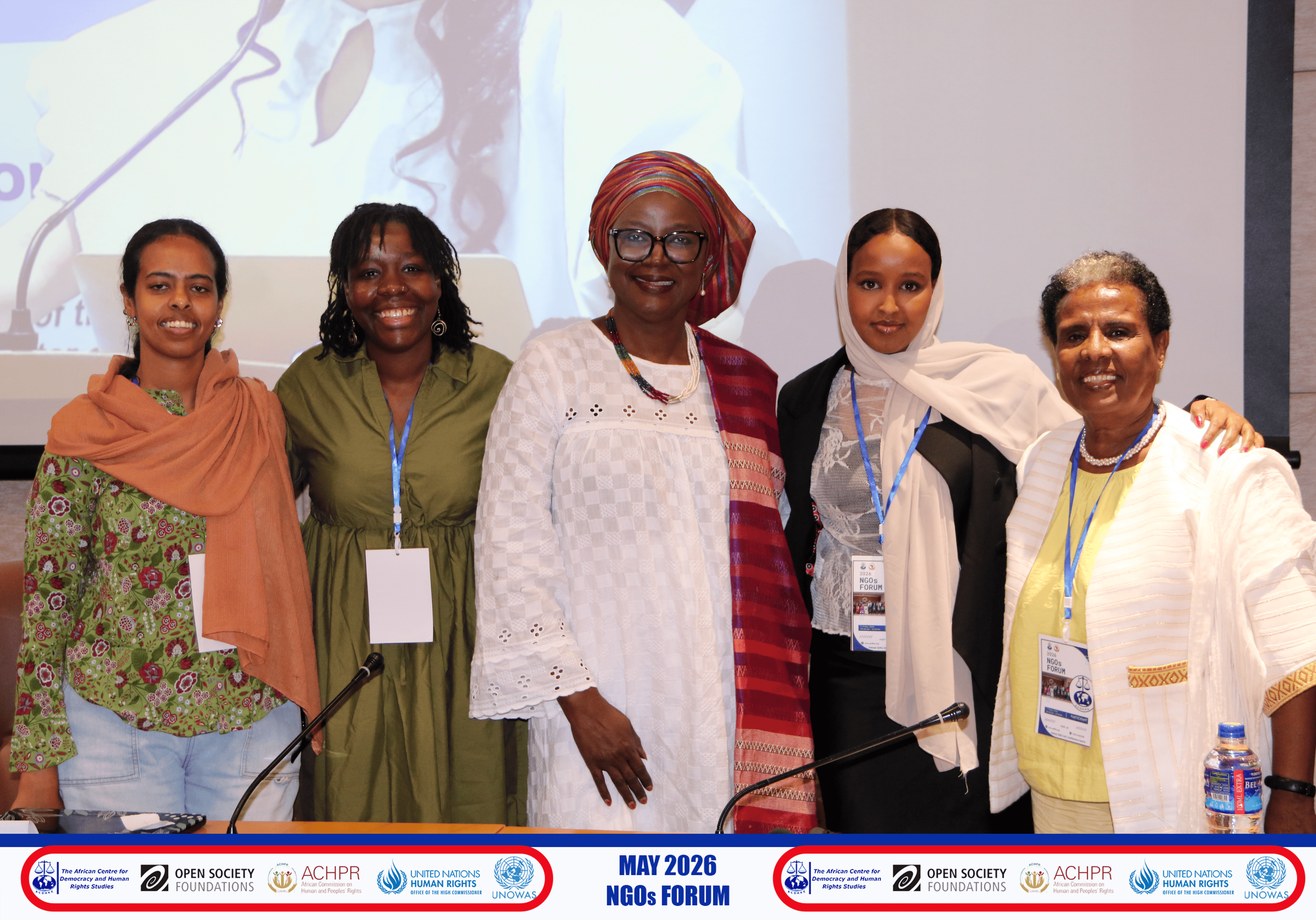
That call echoed strongly during a powerful panel discussion titled “Beyond Ceasefires: Countering Backlash Through Feminist Approaches to Peace and Justice,” held on the sidelines of the NGOs Forum ahead of the 87th Session of the African Commission on Human and Peoples’ Rights in Banjul.
The Forum, organised by the African Centre for Democracy and Human Rights Studies (ACDHRS), is held from 7th to 9th May 2026 at the Sir Dawda Kairaba Jawara Conference Centre in Bijilo.
Moderated by Ramatoulie Jallow of the Strategic Initiative for Women in the Horn of Africa, the panel brought together feminist leaders and rights advocates from across the Horn of Africa, including Naima Hassan from Somalia, Worknesh Begi from Ethiopia, Zainab Mohamed from Sudan, and Janet Ramatoulie Sallah-Njie.
The discussion examined how ongoing conflicts, militarisation, governance failures, displacement, and climate crises continue to disproportionately affect women and girls across the Horn of Africa, while also highlighting the resilience and leadership of grassroots feminist movements operating under dangerous conditions.
Opening the discussion, Ramatoulie Jallow challenged traditional understandings of peace that focus narrowly on ceasefires and elite political agreements while ignoring the social and economic realities faced by women.
She argued that many post-conflict processes fail because they overlook structural inequalities and do not address the violence women continue to experience long after guns fall silent.
For Jallow, sustainable peace requires governments to redirect resources away from militarisation and invest instead in gender-responsive governance, healthcare, education, protection systems, and community-based support structures.
Throughout the session, speakers repeatedly stressed that women are often excluded from formal peace negotiations despite carrying much of the burden of conflict.
Speaking on the situation in Somalia, Naima Hassan described a country where decades of instability, climate shocks, displacement, and weak governance systems have left women and girls highly vulnerable to exploitation and violence.
She spoke about the dangers faced by women journalists, activists, and survivors who publicly address issues such as gender-based violence and women’s rights.
According to her, cultural and religious backlash continues to silence many women human rights defenders, forcing some into hiding or self-censorship.
Yet amid the insecurity, she said Somali women continue to lead critical peacebuilding and humanitarian efforts within their communities.
“Women continue to mediate local conflicts, facilitate dialogue between rival clans, support survivors of violence, provide legal aid, and advocate for women’s inclusion in peacebuilding processes,” she stated.
Her remarks reflected a recurring message throughout the panel — that women are not merely victims of conflict, but central actors in sustaining communities and rebuilding societies.
The discussion took a darker turn as Zainab Mohamed outlined the devastating impact of the ongoing war in Sudan since fighting erupted in 2023.
Describing the humanitarian crisis as catastrophic for women and girls, she revealed that the SIHA Network has documented more than 1,425 cases of gender-based violence and conflict-related sexual violence since the outbreak of war.
According to her, violence against women has spread across nearly every aspect of daily life.
“Women are unsafe everywhere,” she stressed.
She explained that women face threats not only in conflict zones but also in homes, markets, workplaces, and displacement routes.
The collapse of public institutions and the breakdown of healthcare and protection systems have further deepened the crisis, leaving survivors without access to medical care, psychosocial support, legal services, or justice mechanisms.
Still, Zainab pointed to the emergence of women-led emergency response initiatives that continue to fill the gap left by weakened institutions.
Across Sudan, feminist groups and grassroots organisations are reportedly providing safe spaces, legal aid, community protection systems, and support services for survivors despite operating with limited resources and under extreme insecurity.
From Ethiopia, Worknesh Begi highlighted how conflict and climate insecurity in Oromia are intensifying women’s vulnerability and reinforcing harmful patriarchal practices.
She explained that drought, displacement, and increasing competition over scarce resources have contributed to rising child marriages and the exclusion of women from local decision-making structures.
For many displaced women and girls, she said, the loss of livelihoods and education opportunities further increases their exposure to violence and exploitation.
Despite these realities, she praised grassroots women’s organisations working directly with affected communities by offering shelter, psychosocial support, educational opportunities, and survivor-centred legal services.
The panel also examined the broader political environment across the Horn of Africa, where shrinking civic space and attacks on activists continue to undermine women’s rights advocacy.
Several participants noted that women human rights defenders are increasingly targeted online and offline, facing intimidation, threats, arrests, and reputational attacks simply for speaking out.
Providing reflections from the African Commission, Janet Ramatoulie Sallah-Njie emphasised that sustainable peace cannot be achieved through military agreements alone.
She stressed that justice, accountability, inclusion, and women’s participation must remain at the centre of all peacebuilding processes.
“There can be no sustainable peace without women’s rights and no meaningful justice while women remain excluded from shaping the future of their societies,” she stated.
Her remarks reinforced the central argument of the panel — that feminist approaches to peacebuilding are not secondary concerns, but necessary foundations for long-term stability and justice.
As the session concluded, participants engaged in an interactive discussion on the protection of women human rights defenders, the need for stronger accountability mechanisms, and the importance of engaging perpetrators of violence in meaningful peace and reconciliation efforts.
While the conversation exposed painful realities across the Horn of Africa, it also highlighted the determination of African women to continue resisting violence, defending rights, and building peace within their communities.
For many participants, the message was clear: peace cannot simply mean the absence of war. It must also mean safety, dignity, justice, and the full participation of women in shaping the future of their societies.
Author: Halimatou Ceesay
Comments (0)
No comments yet. Be the first to comment!