
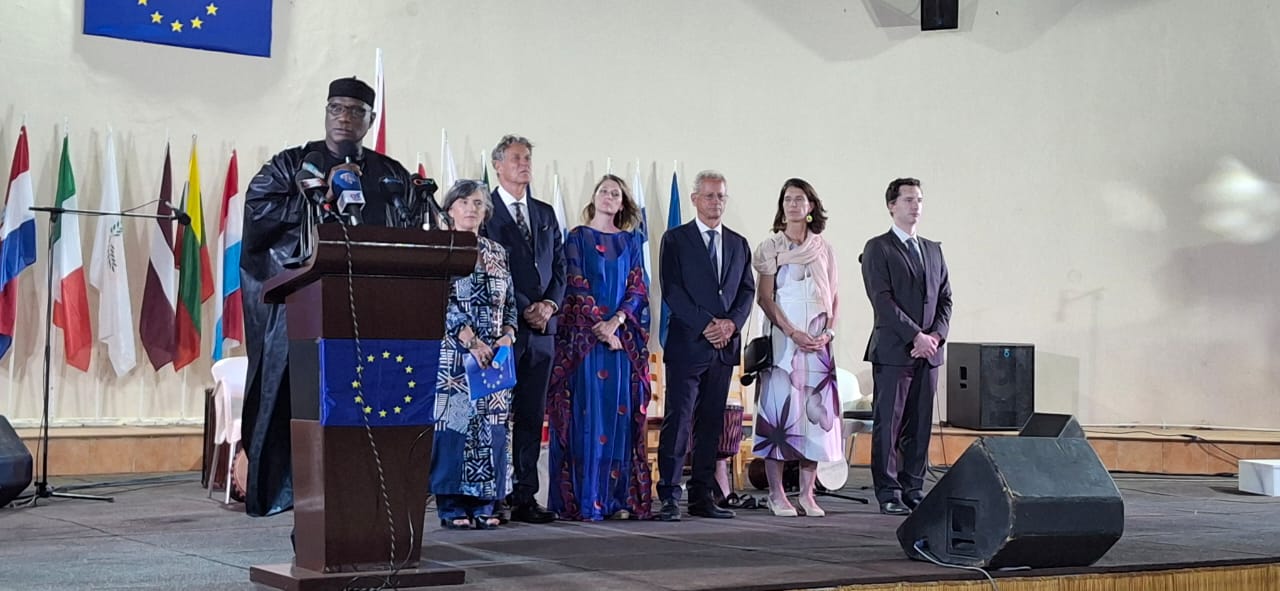
The annual celebration highlighted the enduring relationship between the European Union and The Gambia, while also reflecting on Europe’s historical journey from conflict to unity and the importance of international cooperation in an increasingly uncertain world.
Delivering her remarks at the event, Immaculada Roca i Cortés, the European Union’s Ambassador to The Gambia, welcomed guests and emphasised the significance of Europe Day as a celebration of peace, unity, and partnership.
“It is a real pleasure and a privilege to welcome you today to celebrate Europe Day,” she said, expressing delight at the presence of European diplomats and representatives from member states, including Germany, the Netherlands, Poland, Spain, and France.
The Ambassador reflected on the historical origins of Europe Day, which commemorates the landmark “Schuman Declaration” of 9 May 1950 by former French Foreign Minister Robert Schuman. The declaration proposed pooling the coal and steel industries of France and Germany, making future war between the two historic rivals materially impossible.
According to Ambassador Roca i Cortés, the initiative laid the foundation for what eventually became the European Union, beginning with six countries — France, Germany, Italy, Belgium, Luxembourg, and the Netherlands — and evolving into a union of 27 member states.
“What began as economic cooperation gradually developed into a broader political and social partnership based on peace, prosperity, democracy, and shared freedoms,” she stated.
She noted that the European Union has, over the decades, built strong and enduring partnerships across the globe, including with The Gambia, adding that the relationship has become increasingly important amid growing global instability.
Addressing current international challenges, the Ambassador pointed to armed conflicts in Ukraine, the Middle East, and the Sahel region, warning that multilateralism and peaceful cooperation are increasingly under pressure.
However, she stressed that the values upon which the EU was founded — democracy, rule of law, human rights, good governance, multilateralism, and shared prosperity — remain more relevant today than ever before.
“They are not relics from the last century but a roadmap for this one,” she emphasised.
She further stated that Europe’s security is closely connected to the security of its partners and reiterated the EU’s commitment to working collaboratively with countries like The Gambia to confront shared challenges.
“Europe is and will remain a strong and reliable partner — for cooperation, respect for international law, reciprocity and human dignity — and, with The Gambia, we are turning shared challenges into shared solutions,” she said.
Representing the Government of The Gambia, Sering Modou Njie described Europe Day as a symbol of the power of dialogue, unity, and collective resolve in overcoming divisions and building peaceful societies.
He noted that the ideals celebrated on Europe Day resonate strongly with The Gambia’s national aspirations as the country continues to strengthen democracy, human rights, rule of law, and sustainable development.
“At the bilateral level, these ideals strongly resonate with The Gambia as we continue to partner with the European Union to consolidate democracy, strengthen institutions, promote human rights, rule of law, pursue sustainable national development and contribute to global peace, security and development,” he stated.
The Foreign Affairs Minister highlighted the evolution of relations between The Gambia and the European Union, describing it as a mature and strategic partnership rooted in mutual respect, trust, shared interests, and common values.
According to him, the European Union remains one of The Gambia’s most reliable development partners, consistently supporting the country during periods of both progress and national challenges.
He acknowledged the EU’s contributions across several sectors, including infrastructure, governance, transitional justice, trade, education, energy, climate resilience, healthcare, youth empowerment, and institutional strengthening.
Minister Njie particularly praised initiatives such as the Youth Empowerment Project, noting their significant impact on women and young people through entrepreneurship support, skills development, and economic opportunities.
“The cooperation continues to deliver tangible, impactful and visible benefits for our shared commitment to sustainable development, peace, democracy, and inclusive growth,” he added.
Beyond the official speeches, the Europe Day celebration also served as a platform for cultural exchange and diplomatic engagement. Guests enjoyed musical performances, networking opportunities, and a variety of meals in an atmosphere marked by friendship and cooperation.
As global tensions continue to test international partnerships and multilateral systems, the celebration in Bakau stood as a reminder of the importance of solidarity, dialogue, and shared responsibility between nations.
For both the European Union and The Gambia, Europe Day 2026 was not only a commemoration of history but also a reaffirmation of a partnership focused on peace, development, and a shared vision for the future.
Author: Halimatou Ceesay
Comments (0)
No comments yet. Be the first to comment!