
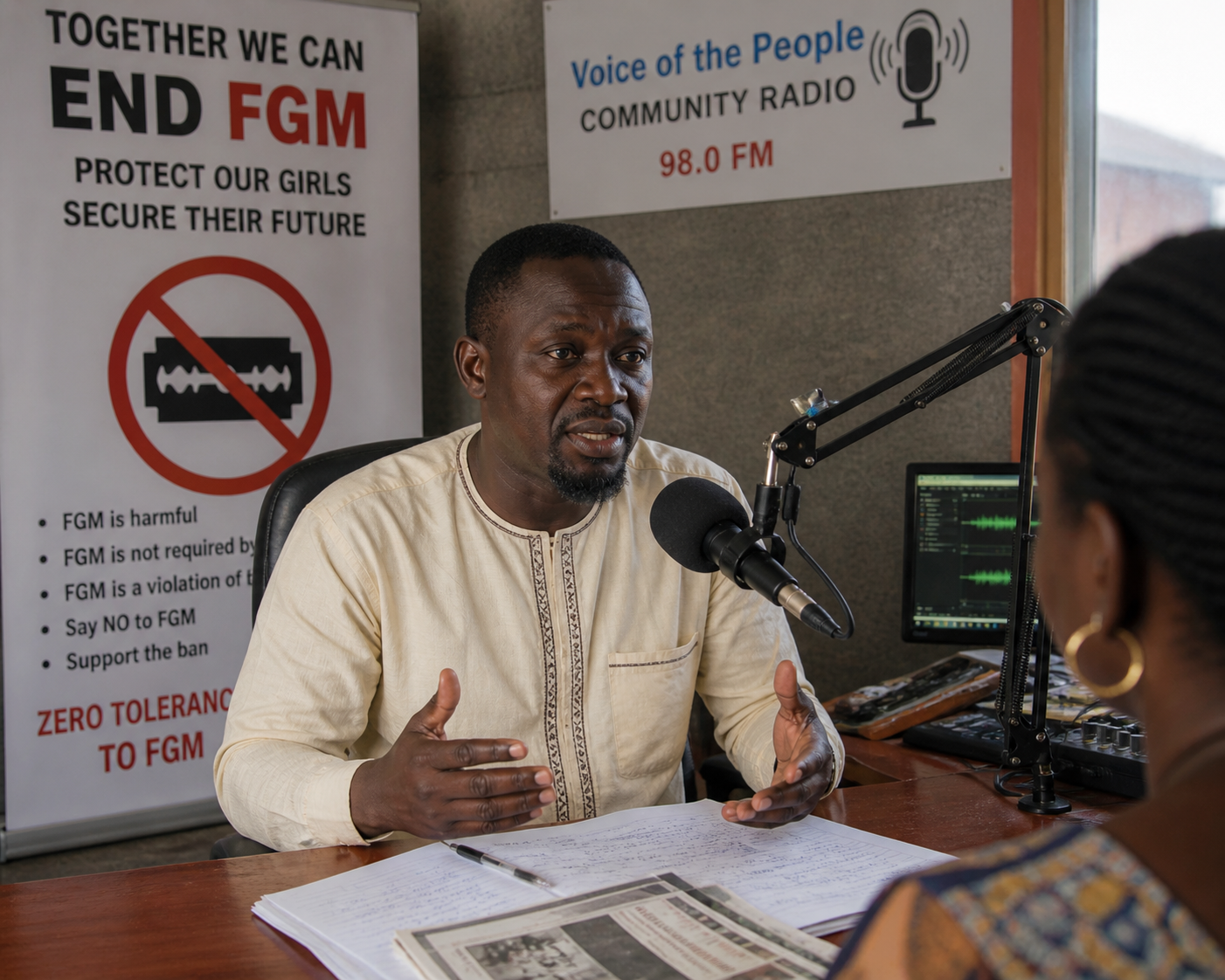
For Lama, FGM was once unquestioned.
Speaking to this reporter on April 18, 2026, Lama recalls, “People said it was our tradition. Something that existed long before we were born.”
Like many in his community, Lama grew up believing that every girl had to undergo the practice. It was widely accepted, reinforced by parents and grandparents who saw it as essential for a girl’s upbringing and future marriage. Some believed it reduced a woman’s sexual desire, ensuring faithfulness, while others linked it to religion and cleanliness.
“During our childhood, everybody practised it,” Lama says. “No one saw it as a problem.”
That perception began to shift in 2017 when Lama joined the media. Through trainings, research, and exposure to different perspectives, he started to question what he had always accepted as normal.
“I read articles, attended trainings, and spoke to women who had gone through FGM,” he explains. “That is when I realised how harmful it is.”
The stories he heard were difficult to ignore—accounts of pain, trauma, and long-term complications that extended into marriage and adulthood. Some women described reliving the same pain on their wedding night, especially those who had undergone more severe forms of cutting.
As a journalist, Lama turned his growing awareness into action. He hosted radio programs, engaged communities, and used his platform to spark conversations around FGM—conversations that were once avoided or dismissed.
But one of the biggest challenges he encountered was the belief that FGM is solely a women’s issue.
“Some people say men should not be involved,” he says. “But that is not true.”
Lama strongly believes that men have a critical role to play, especially as fathers and decision-makers within families.
“These are our daughters, too,” he says. “If men are involved in the discussions, they can help protect their children—especially because young girls do not understand what is being done to them.”
Despite this, he notes that in communities like Basse, many men remain disengaged or sceptical.
“You will hear some men say people are just talking for money,” he says. “That shows there is still a lack of understanding.”
To address this gap, Lama emphasises the need for more awareness campaigns targeting men. He points to the radio as a powerful tool in the region, where many rely on it for information, alongside community outreach and direct engagement.
“Education is key,” he says. “People need to understand the reality.”
Lama’s own beliefs have evolved significantly over time. Where he once accepted FGM as part of his culture, he now firmly rejects it.
“Before, I would not say my daughter would avoid it,” he admits. “But today, I will not allow it.”
His stance is rooted in knowledge and conviction. He now speaks openly against the practice and does not hesitate to advise others, even if they choose not to follow his guidance.
Still, he understands that change will not come overnight.
“You cannot expect people to abandon something they have practised for decades in just a short time,” he says. “It requires continuous sensitisation and engagement.”
He believes that involving respected community elders can help accelerate progress, while also encouraging people to preserve other aspects of culture that do not cause harm.
“Not everything in our tradition is bad,” he says. “We can keep what is good—like traditional marriages—without continuing harmful practices like FGM.”
Lama also points to the importance of the law. The 2015 ban on FGM in The Gambia, he says, is a necessary step in protecting girls, though more awareness is needed to ensure people understand its purpose and consequences.
“If people know the risks and the law, they will think twice,” he adds.
Today, Lama Jallow is not just reporting on change—he is part of it. Through his voice and his work, he is helping to reshape conversations in his community, one discussion at a time.
His message to fathers is clear: “This is not just talk—it is a reality affecting our daughters. Learn, ask questions, and protect them.”
In Basse, where silence once surrounded the issue, voices like Lama’s are beginning to break through—challenging tradition, and opening the door to change.
This story is part of the "Breaking the Silence: Voices of FGM Survivors" podcast funded by the Foundation for Women's Health, Research and Development (FORWARD UK).
Author: Kaddy Sowe
PC: AI-Generated
Comments (0)
No comments yet. Be the first to comment!