
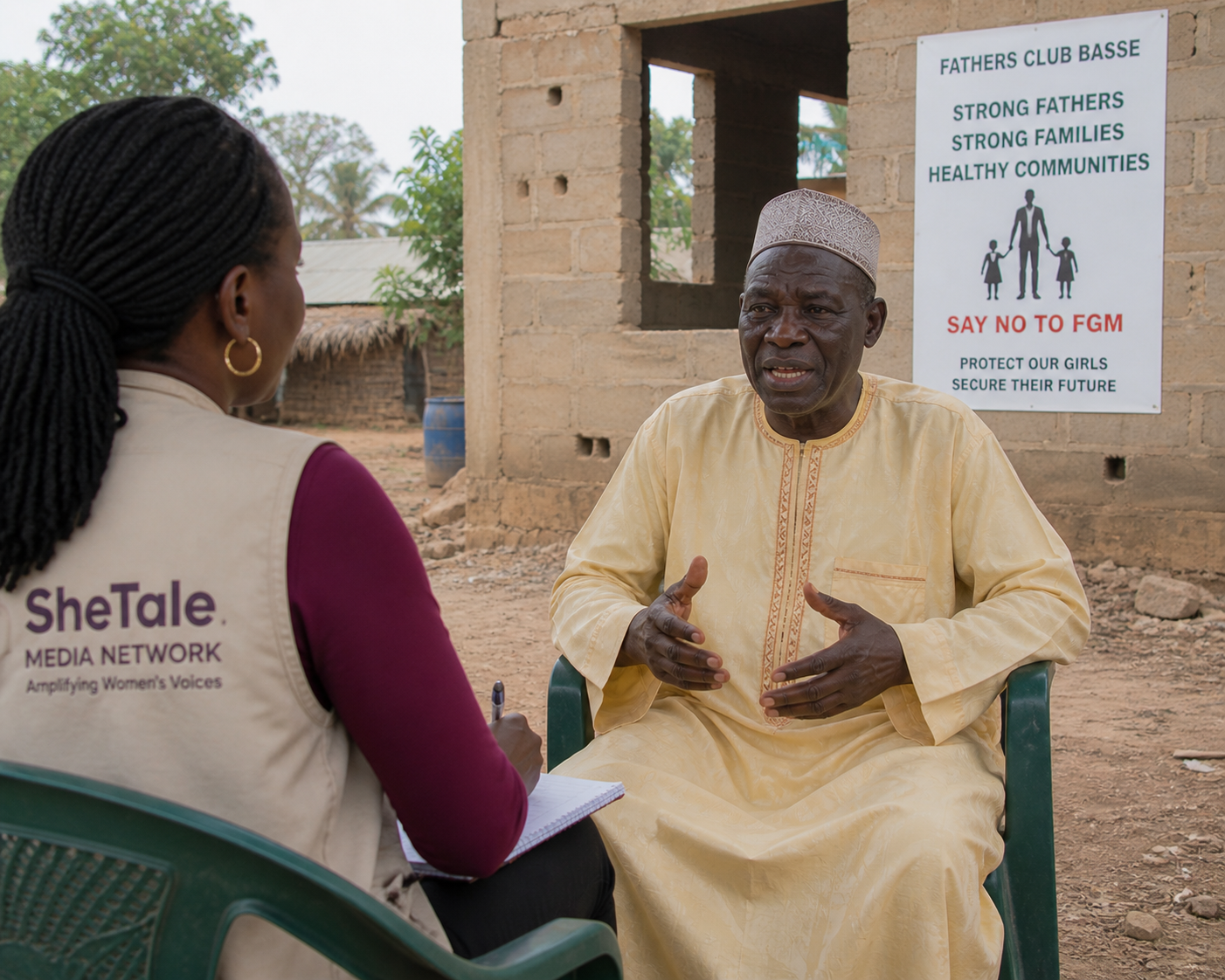
But for Saikouba Jarra, a member of the Fathers Club in Basse Kabakama, that silence is beginning to change.
Jarra joined the Fathers Club in 2025, inspired by the existence of mothers’ clubs across communities in The Gambia. To him, men also needed a platform where they could discuss family responsibilities, community challenges, and their role in protecting women and children.
Speaking to this reporter in April 2026, Jarra explained, “What motivated me is that women had mothers’ clubs, so men too should also have a Fathers Club,” he explained.
Since joining the group, Jarra says his understanding of FGM and gender roles within the household has transformed significantly. Like many Gambians, he grew up believing FGM was simply a cultural tradition inherited from elders.
“FGM is a tradition that we met our elders doing,” he said.
“But that it causes harm is something I only came to understand recently.”
His turning point came during a training organised at the Basse Area Council, where discussions on the health consequences of FGM opened his eyes to realities he had never fully understood before.
“Before, I only used to hear about it on television,” he recalled.
“But during the training, I learned about the infections, complications, and other sicknesses linked to it. That was when I realised it is not good.”
For Jarra, one of the biggest obstacles in addressing FGM is the long-standing belief that women’s issues should only be discussed among women, while men deal solely with men’s matters.
“In our culture, men think women’s issues belong to women,” he said. “That is why many men stay silent.”
He believes this silence delayed meaningful dialogue around FGM for decades. According to him, if conversations involving both men and women had started earlier, resistance surrounding the issue might not have been so strong today.
“If women and men had joined hands earlier to talk about it, we would not be struggling so much now over whether it should stop or not,” he explained.
Still, Jarra acknowledges that changing deeply rooted cultural beliefs requires patience and understanding rather than confrontation.
“You cannot convince everyone immediately,” he said. “You have to strategise and take it easy. If you use force, people will resist.”
At home, Jarra has started these conversations with his own family, including his two wives. He says the process has been gradual, built on trust and respectful discussion rather than pressure.
“Changing someone’s mind cannot happen overnight,” he noted. “Even now, I am still discussing these things with my family.”
Beyond the issue of FGM, Jarra has also become increasingly vocal about the unequal burden placed on women in many Gambian households. Through the Fathers Club, he now advocates for men to play a more active role in supporting their wives and sharing responsibilities at home.
He recalls one incident during the rainy season that deeply affected him. While travelling, he encountered a woman walking nearly 12 kilometres in heavy rain with a young child. The woman, who lived in a refugee settlement with her cattle, explained that her husband owned a motorbike but had no fuel to transport her.
Concerned for her safety, Jarra offered her a ride home.
When he later met the woman’s family and husband, he used the opportunity to discuss how husbands and wives could support one another better.
“I told him that some heavy work should not always be left for women,” Jarra recounted. “Women carry too many responsibilities.”
He says such experiences have strengthened his belief that many marital problems, including divorce, are linked to the overwhelming pressures placed on women.
“In many homes, almost 85 per cent of the responsibilities are on women,” he said. “Sometimes women ask for a divorce not because they do not want the marriage, but because they are tired.
”
The Fathers Club, according to Jarra, has become an important space for sensitisation and reflection within the community. Members regularly share messages, organise discussions, and encourage men to rethink traditional attitudes toward women and girls.
Although participation can sometimes be difficult due to economic challenges and the voluntary nature of the work, Jarra believes the impact is already visible.
“People are beginning to appreciate these discussions,” he said. “Even if we do not have sponsors now, we will continue to sacrifice and do it voluntarily.”
For him, real change begins with honest conversation, compassion, and the willingness of men to listen and evolve.
As debates around FGM and women’s rights continue across The Gambia, voices like Saikouba Jarra’s reflect a growing movement among men who are beginning to see gender equality not as a women’s issue alone, but as a shared responsibility for stronger families and healthier communities.
This story is part of the "Breaking the Silence: Voices of FGM Survivors" podcast funded by the Foundation for Women's Health, Research and Development (FORWARD UK).
Author: Fatou S. Sanyang
PC: AI-Generated
Comments (0)
No comments yet. Be the first to comment!